Victorian law will not let you take the possum away. It has to be released within 50 metres of the roof it just came out of — which means the only question that actually matters is where it sleeps tomorrow night.
Why the nest box is not optional decoration
- A trapped brushtail must be released on the same property, within 50 metres, after sunset the same day.
- Seal the roof without offering an alternative and the possum will spend weeks trying to get back in — often finding a new gap.
- Natural tree hollows large enough for a brushtail take well over a century to form. Suburban Melbourne has very few left.
- Box design is not arbitrary. Entrance size, height and orientation decide whether it gets used or ignored.
The logic nobody explains properly
Most possum advice stops at “get it out and seal the roof”. That is half a plan, and the missing half is why so many households end up paying twice.
Under the Wildlife Act 1975 (Vic), a brushtail possum trapped in a building may only be released on the same property, no more than 50 metres from the capture point, after sunset on the day it was caught. If that is not reasonably possible, it must be humanely euthanised by a registered vet within 24 hours. There is no legal option that involves driving it to a park.
So the animal stays. It is nocturnal, territorial, and it has just lost its den. If the roof is sealed properly it cannot go back — but it still needs somewhere dark, dry and elevated to sleep before dawn. Without that, it will spend night after night working the roofline looking for a gap you missed.
A nest box turns an eviction into a relocation. It is the difference between displacing a possum and rehousing it.
The specification that actually matters
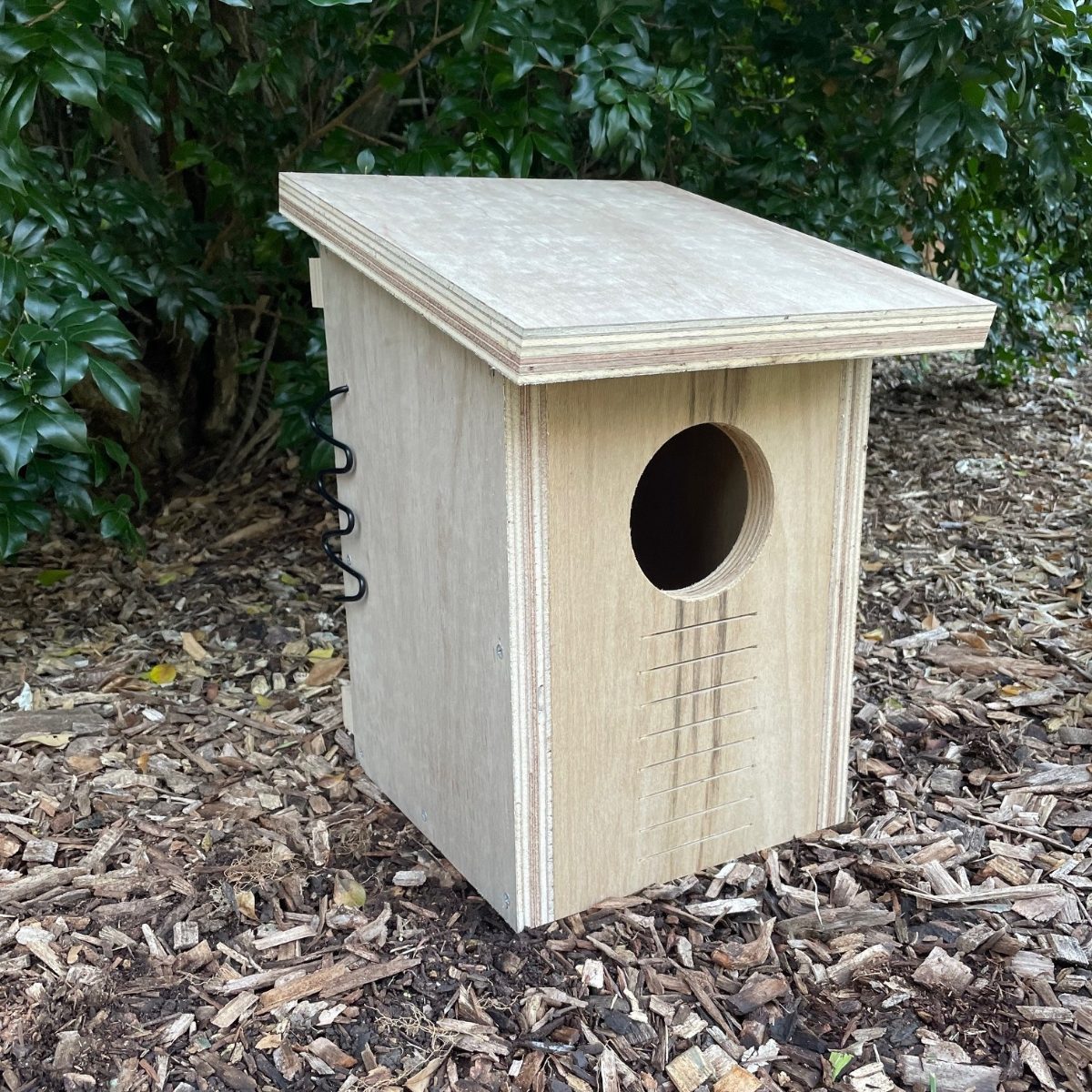
A possum box is not a birdhouse scaled up. Get the entrance diameter wrong and you either exclude the animal you are trying to house, or you invite a different one.
Brushtail possum box — working dimensions
Vertical box, based on Wildlife Victoria and wildlife rescue guidance. The depth below the entrance is the detail most home-built boxes get wrong.
Brushtail versus ringtail: different animals, different boxes
| Specification | Brushtail possum | Ringtail possum |
|---|---|---|
| Entrance diameter | 100–120 mm | 70–80 mm, or an open-fronted dome |
| Internal floor | ~300 × 300 mm | ~200 × 200 mm |
| Total height | 400–500 mm | 300–400 mm |
| Mounting height | 3–5 m | 2–4 m, often in dense shrubs |
| Natural preference | Tree hollows — readily accepts boxes | Builds its own drey from twigs and bark |
| Likelihood of use | High if sited correctly | Lower — will often build a drey instead |
| Legal note | May be trapped in a building under strict conditions | Cannot be trapped without a permit |
Orientation: the free decision that decides everything
Melbourne summers are the constraint. A box facing west or north-west takes the full afternoon sun, and a sealed timber box in direct sun can become lethally hot for an animal sleeping inside it through the day.
Wildlife Victoria guidance is to face the entrance south-east, or as far from the afternoon sun as the tree allows. This costs nothing at installation and is close to impossible to fix afterwards without remounting the whole box.
Which way to face the entrance
Melbourne. Avoid the hot afternoon quadrant; favour morning sun and afternoon shade.
Why the hollows are gone in the first place
It is worth understanding why this is even necessary. Eucalypt hollows large enough to house a brushtail possum do not form quickly — they are the product of decades of fungal decay and termite activity after limb loss, and hollows of usable size generally take well over a hundred years to develop.
Suburban development removed most of the old-growth trees that carried them. What remains across Melbourne’s south-east is largely younger planted stock with no hollows at all. The result is a genuine housing shortage for hollow-dependent species — which is precisely why roof cavities became attractive. A roof is a warm, dry, elevated hollow that never needed a century to form.
You are not competing with an abundance of natural alternatives. If your roof was the best den in the area, sealing it without providing a replacement leaves the animal with genuinely nowhere to go — and a strong incentive to break back in.
Six mistakes that stop a box being used
Mounted too low
Below about three metres, boxes are exposed to dogs, cats and disturbance. Possums assess predation risk before they commit to a den.
Thin timber
Boxes built from thin ply swing wildly in temperature. Use timber around 20 mm or thicker so the interior stays stable through a Melbourne summer.
Nailed straight to the tree
Damages the tree and fails as it grows. Use straps or lag bolts with spacers that can be adjusted over time.
No drainage
A few small holes in the floor. Without them the box holds water, the bedding rots and the animal leaves.
Entrance too large
Above about 120 mm you are no longer building a possum box. You are building something a range of other animals can occupy first.
Installed after the seal
Sequence matters. The box should be up and available before the roof is closed, not weeks afterwards.
How the whole sequence should run
Order is everything on a possum job, and the nest box has a specific place in it. Inspect the roof and map every entry point. Confirm whether a dependent joey is present, because sealing a mother out while young remain inside is both cruel and unlawful. Install the nest box before the eviction, so an alternative exists on the night the animal is released. Trap and release after sunset within the legal 50 metres. Seal every entry point while the cavity is confirmed empty. Clean and deodorise. Return to verify the box is being used and the roof has stayed closed.
That sequence is why this work is usually handed to a licensed operator. Households across Melbourne’s south-east typically engage a technician for possum removal in Endeavour Hills and neighbouring suburbs because the legal timing, the joey check and the box installation all have to line up — and a box installed after the roof is sealed is usually a box that never gets used.
Possums assess a new den over time. Adoption can take anywhere from a few nights to several months, and there is no guarantee a specific animal takes a specific box. What a box reliably does is give a displaced possum a legitimate option — which measurably reduces the pressure on your roofline.
Frequently asked questions
Do I legally have to install a nest box?
No. The law requires legal release within 50 metres on the same property; it does not mandate a nest box. But because the animal must remain on your property, a box is the practical measure that stops it targeting your roof again. It is best practice rather than a legal obligation.
Where exactly should I put it?
On a mature tree three to five metres up, entrance facing south-east or otherwise away from afternoon sun, with a clear approach route for the animal but no branch directly at the entrance that a cat could use. Keep it away from the house rather than right against it.
Will the possum use the box straight away?
Sometimes within days, sometimes after months. Installing the box before the eviction rather than after gives the best chance, since the animal has already had the opportunity to investigate it while still living in the roof.
What if another animal takes the box first?
It happens — rainbow lorikeets, cockatoos and feral bees will all occupy a cavity. Keeping the entrance at 100 to 120 millimetres reduces competition. If a protected native species has moved in, leave it and install a second box.
Does the box need maintenance?
Check it annually. Clear debris, confirm the mounting straps have not begun to strangle the growing tree, and check the lid seal and drainage holes. A hinged lid makes this a five-minute job.
Can I just put the box up and skip proofing the roof?
No. A box is an alternative, not a deterrent. A possum with an established roof den and a new box outside will almost always keep the roof. Proofing is what closes that option; the box is what makes the closure humane and durable.
- Wildlife Act 1975 (Vic) — trapping, 50-metre same-property release, 24-hour euthanasia requirement, and permit requirement for ringtail possums.
- Wildlife Victoria, How to Build a Possum Nest Box — entrance diameter, depth below entrance, mounting height and south-east orientation guidance.
- Wildlife rescue nest box construction guidance — internal dimensions, timber thickness, drainage and mounting method.
- Eucalypt hollow formation timescales and hollow-dependent fauna in urban landscapes.